As polymer materials are increasingly used in electronics, electrical equipment, construction, automotive components, transportation, and consumer products, fire safety has become an important consideration in material development. Flame retardants are widely used to reduce flammability, slow flame propagation, and improve the fire resistance of polymer-based materials.
Among different flame retardant technologies, halogen-free flame retardants have attracted increasing attention. Phosphorus-, nitrogen-, mineral-, silicon-, and boron-based systems provide alternative approaches to traditional halogen-containing flame retardants and are being developed for a wide range of polymer applications.
一,What Are Halogen-Free Flame Retardants?
Halogen-free flame retardants are flame-retardant materials that do not use bromine, chlorine, or other halogen elements as their principal flame-retardant component.Instead, they control combustion through mechanisms such as heat absorption, dilution of combustible gases, formation of protective char, and interruption of flame-propagating reactions.It is important to note that halogen-free does not automatically mean that a product is non-toxic or environmentally harmless. The overall safety and environmental profile depends on the specific chemical structure, formulation, concentration, application, and applicable regulations.

二,Why Are Halogen-Free Flame Retardants Increasingly Important?
Traditional halogen-containing flame retardants can provide effective flame inhibition, particularly through gas-phase mechanisms. However, concerns about certain halogenated substances and the potential formation of corrosive hydrogen halides during combustion have encouraged the development of alternative flame-retardant technologies.As a result, manufacturers and material developers are increasingly investigating non-halogenated flame retardants that can provide effective fire protection while maintaining the required mechanical, thermal, electrical, and processing properties of the polymer.The objective is not simply to replace one chemical with another. Modern flame retardant development focuses on achieving an appropriate balance between fire performance, material properties, processing efficiency, regulatory requirements, and cost.
三,How Do Halogen-Free Flame Retardants Work?
Different halogen-free flame retardant systems can work through different mechanisms.

Condensed-Phase Action
Some flame retardants promote the formation of a protective carbonaceous layer, or char, on the polymer surface during combustion. This char can act as a barrier that reduces heat transfer and limits the release of combustible decomposition products.Phosphorus-based flame retardants are particularly important in this mechanism because phosphorus-containing compounds can promote char formation in suitable polymer systems.
Gas-Phase Action
Certain flame retardants can interfere with the chemical reactions that sustain combustion in the gas phase. Phosphorus-containing compounds, for example, can generate active species that interfere with flame-propagating radicals.
Endothermic Decomposition
Some inorganic flame retardants, such as aluminum hydroxide (ATH) and magnesium hydroxide (MDH), decompose at elevated temperatures and absorb heat. They can also release water vapor, which helps cool the polymer surface and dilute combustible gases.
Intumescent Protection
Intumescent flame retardants (IFRs) form an expanded protective char layer when exposed to heat or flame. The resulting barrier can reduce heat and mass transfer between the flame and polymer.Intumescent systems commonly combine an acid source, a carbon source, and a blowing agent. Phosphorus-nitrogen combinations are widely investigated because of their synergistic flame-retardant effects.
四,Major Types of Halogen-Free Flame Retardants
1. Phosphorus-Based Flame Retardants:Phosphorus-based flame retardants are among the most widely studied halogen-free technologies. They include phosphates, phosphonates, phosphinates, phosphine oxides, red phosphorus, and related compounds.Depending on their chemical structure and polymer matrix, phosphorus compounds may operate through gas-phase flame inhibition, condensed-phase char formation, or both.They are widely investigated for engineering plastics, polyamides, polyesters, epoxy resins, polyurethane, and other polymer systems.
2. Nitrogen-Based Flame Retardants:Nitrogen-containing compounds such as melamine and its derivatives are another important category.
They can release nitrogen-containing gases during thermal decomposition and may contribute to gas dilution and char formation. Phosphorus-nitrogen flame retardant systems are particularly important because the two components can provide complementary mechanisms.
3. Metal Hydroxides:Aluminum hydroxide and magnesium hydroxide are widely used inorganic halogen-free flame retardant additives.
They are attractive because of their established industrial use and relatively straightforward flame-retardant mechanism. However, relatively high loading levels may be required, which can negatively affect mechanical properties and processing performance.
4. Intumescent Flame Retardants:Intumescent systems are increasingly important for polymer fire protection. When heated, they generate an insulating char layer that helps protect the underlying polymer.
They are particularly attractive when manufacturers want to reduce the reliance on conventional halogen-containing flame retardants while maintaining effective fire protection.
五,Applications of Halogen-Free Flame Retardants
Halogen-free flame retardants are being developed and applied across a wide range of polymer materials.

Typical applications include:Electrical and electronic components,Wire and cable materials,Automotive plastics,Construction materials,Polyurethane foams,Epoxy resins,Polypropylene and other polyolefins,Engineering plastics,Coatings and polymer composites.The appropriate flame retardant depends heavily on the polymer type and processing conditions. A formulation that performs well in polypropylene may not provide the same results in polyurethane or epoxy resin.Therefore, product selection should consider polymer compatibility, processing temperature, loading level, dispersion, mechanical properties, thermal stability, and required fire-test performance.
六,Future Trends in Halogen-Free Flame Retardant Technology
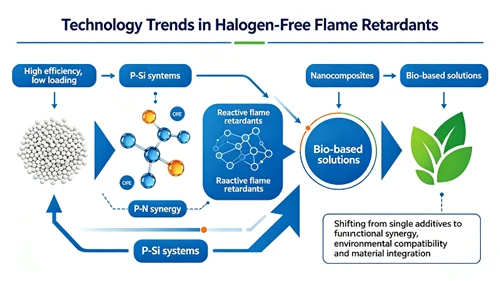
The development of halogen-free flame retardants is moving toward higher efficiency and multifunctional performance.Current research focuses on several areas, including phosphorus-nitrogen synergy, phosphorus-silicon systems, reactive flame retardants, nanocomposite technologies, improved dispersion, and bio-based flame-retardant materials.Another important direction is reducing the amount of flame retardant required while maintaining fire performance. High additive loading can negatively affect mechanical strength, processability, appearance, and other properties.Recent research is also exploring intrinsically flame-retardant polymer materials and bio-based systems, indicating that future solutions may increasingly integrate flame resistance directly into polymer structures rather than relying exclusively on conventional additives.