Sunlight is one of the major causes of degradation in plastics, coatings, adhesives, fibers and other polymer-based materials. Prolonged exposure to ultraviolet (UV) radiation can cause color fading, yellowing, loss of gloss, surface cracking, chalking, embrittlement and deterioration of mechanical properties.To improve outdoor durability, formulators often use UV absorbers and light stabilizers. However, these terms are sometimes used interchangeably, which can cause confusion when selecting additives.
So, what is the difference between a UV absorber and a light stabilizer? Are they the same thing? And when should manufacturers use a UV absorber, a HALS light stabilizer, or a combination of both?
The key is that they protect polymers through different mechanisms.
What Is a UV Absorber?
 A UV absorber (UVA) is an additive designed to absorb harmful ultraviolet radiation before that energy can cause significant damage to a polymer.When a polymer is exposed to sunlight, UV radiation can initiate photochemical reactions in the polymer matrix. A UV absorber preferentially absorbs part of this high-energy UV radiation and dissipates the absorbed energy as low-level heat. This reduces the amount of damaging UV energy reaching the polymer chains.
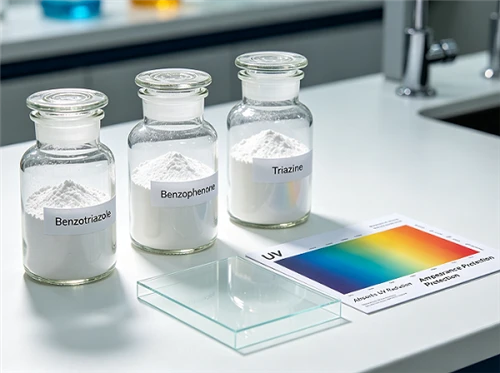
Common UV absorber families include benzotriazoles, benzophenones and triazines. Benzotriazole UV absorbers, such as UV-328, UV-329 and UV-326, are widely used where broad UV protection and good compatibility are required.
This makes a UV absorber for plastics particularly useful when the main concern is protecting the material from the initial impact of UV radiation.
What Is a Light Stabilizer?
 Light stabilizer is a broader term for additives that improve the resistance of polymers and coatings to light-induced degradation. One of the most important types of light stabilizers is HALS, or Hindered Amine Light Stabilizers.Unlike a UV absorber, HALS does not primarily work by absorbing UV radiation. Instead, HALS helps interrupt the photooxidative degradation cycle by interacting with free-radical intermediates generated during polymer degradation. HALS can be regenerated during the stabilization process, which contributes to its high efficiency and long-term performance.
This distinction is important when comparing a UV absorber vs. HALS.
A UV absorber acts more like a filter, reducing the amount of harmful UV radiation entering the polymer. HALS acts more like a chemical defense system, suppressing the free-radical reactions that occur during photooxidation.
UV Absorber vs. Light Stabilizer: The Main Difference
The simplest way to understand the difference is to look at their mechanisms.
|
Feature |
UV Absorber |
HALS Light Stabilizer |
|
Main function |
Absorbs UV radiation |
Suppresses free-radical degradation |
|
UV absorption |
Yes |
No, not its primary function |
|
Main protection mechanism |
Converts absorbed UV energy into heat |
Radical scavenging / stabilization cycle |
|
Typical benefit |
Protects polymer and appearance |
Protects polymer surface and bulk |
|
Particularly useful for |
Coatings, plastics, transparent materials |
Polyolefins, films, fibers, outdoor plastics |
|
Can be combined? |
Yes |
Yes |
Therefore, asking whether a UV absorber or light stabilizer is "better" does not always have a single answer. They are designed to address different stages of the photodegradation process.
UV Absorber vs. HALS for Plastics

For manufacturers searching for a UV stabilizer for plastics, the choice depends heavily on the polymer, product geometry, pigmentation, outdoor exposure and expected service life.
UV absorbers can be particularly useful when protection against UV radiation and appearance retention are important. They can help reduce discoloration and protect the polymer matrix from UV exposure.
HALS, on the other hand, are highly effective in many polyolefin applications and are particularly useful in products with large exposed surface areas, including films and fibers. Industry technical information identifies HALS as highly effective for polyolefin light stabilization.
For this reason, applications such as outdoor polypropylene products, polyethylene films and agricultural plastics may use HALS as an important component of the stabilization package.
Do You Need Both UV Absorber and HALS?
 In many demanding applications, the answer is both.
A UV absorber + HALS system can provide complementary protection because the two additives address different aspects of polymer photodegradation. The UV absorber reduces harmful UV energy entering the material, while HALS helps control the free-radical reactions responsible for photooxidative degradation.
This approach is already widely used in commercial stabilization systems. BASF, for example, describes UVA/HALS combinations as complementary technologies and offers blends designed to improve color and gloss retention and long-term durability.
For outdoor coatings, automotive plastics, architectural coatings, films and other demanding applications, a combination of UV absorber and HALS light stabilizer may therefore provide more comprehensive protection than relying on either additive alone.
UV Absorber or HALS: Which One Should You Choose?
There is no universal best UV stabilizer for plastics. The correct additive depends on the application.
If the primary requirement is to filter UV radiation and protect color, transparency or appearance, a suitable UV absorber may be the starting point.
If the material is highly susceptible to photooxidation and requires long-term protection against surface cracking, chalking and mechanical deterioration, HALS may play a more important role.
For demanding outdoor applications, formulators may use UV absorber and HALS together. The final formulation may also include antioxidants and other stabilizers because thermal processing and oxidation can contribute to polymer degradation as well. Commercial stabilization systems are often designed around several complementary mechanisms rather than a single additive.
Choosing the Right UV Absorber for Your Application
Not all UV absorbers have the same performance. Benzotriazole UV absorbers are commonly selected for broad UV protection, while different chemical families may be preferred depending on the polymer and processing conditions.
For example, UV-326, UV-328 and UV-329 are benzotriazole-type UV absorbers with different molecular structures and application profiles. When selecting a UV absorber for plastics, formulators should consider polymer compatibility, UV absorption range, volatility, migration resistance, processing temperature, transparency and long-term weathering requirements.
The same principle applies to HALS. Different HALS grades are designed for different polymer systems, processing conditions and end-use applications.
Therefore, simply selecting the additive with the highest UV absorption does not necessarily produce the best final result.
UV Absorbers and Light Stabilizers in Coatings
The distinction between these technologies is also important in coatings.
UV absorbers can filter harmful UV radiation and help protect both the coating and the underlying substrate. HALS can suppress free-radical degradation and help maintain surface properties such as gloss while reducing cracking and chalking.
This is why UV absorber and HALS blends for coatings are widely used in automotive, industrial, architectural and other exterior coating applications.
For clear coats and transparent coatings, the optical properties of the UV absorber are especially important. For pigmented coatings, compatibility with pigments, resin systems and other additives must also be considered.
The difference between a UV absorber and a light stabilizer can be summarized simply: a UV absorber primarily absorbs harmful UV radiation, while a HALS light stabilizer primarily controls the free-radical reactions associated with photooxidative degradation.
They are therefore not simply interchangeable products.
For relatively straightforward UV protection, a suitable UV absorber may provide the required performance. For demanding outdoor plastics and coatings, HALS can provide highly effective long-term stabilization. In many high-performance formulations, however, the most effective approach is to combine a UV absorber and HALS so that they protect the polymer through complementary mechanisms.
The right UV stabilizer for plastics ultimately depends on the polymer, processing conditions, product thickness, outdoor exposure, color requirements and expected service life. Laboratory weathering and formulation testing remain important for determining the appropriate additive type and dosage.