Ultraviolet (UV) radiation is one of the major causes of photo-aging and degradation in polymers, textiles, coatings, plastics, and other organic materials. Prolonged exposure to UV light can cause discoloration, loss of mechanical strength, cracking, surface deterioration, and reduced service life. UV absorbers are therefore widely used as an important component of light stabilization systems.
UV absorbers selectively absorb high-energy ultraviolet radiation, particularly within specific wavelength ranges, and convert the absorbed energy into a less harmful form, primarily through molecular relaxation and heat dissipation. By reducing the amount of UV energy reaching the polymer matrix, they help minimize UV-induced photophysical and photochemical degradation.
一,Principles of UV Absorbers

Different types of UV absorbers use different molecular structures and mechanisms to provide protection against ultraviolet radiation. The most common chemical families include benzophenone UV absorbers, benzotriazole UV absorbers, salicylate UV absorbers, and triazine UV absorbers. Other light-stabilizing technologies, such as HALS (Hindered Amine Light Stabilizers) and light-screening agents, can also be incorporated into stabilization systems.
1. Benzophenone UV Absorbers
Benzophenone UV absorbers are one of the earliest and most widely used classes of organic UV stabilizers. Their molecular structures generally contain carbonyl and hydroxyl groups capable of forming intramolecular hydrogen bonds.
When the molecule absorbs UV radiation, the absorbed energy is dissipated through molecular excitation and subsequent relaxation processes. The intramolecular hydrogen bond plays an important role in this energy-transfer mechanism. Proper molecular design can enable the absorber to efficiently protect polymers while minimizing absorption in the visible-light region.
The substitution pattern of the benzophenone molecule also affects its UV absorption range, photostability, polymer compatibility, and color characteristics. These factors determine its suitability for different plastics, coatings, textiles, and other applications.
2. Salicylate UV Absorbers
Salicylate UV absorbers were among the earliest organic UV stabilizers used commercially. Their UV absorption is relatively limited compared with more advanced benzotriazole and triazine systems.
Some salicylate compounds undergo structural changes during UV exposure, which can modify their absorption characteristics. Because of their relatively narrow absorption range and performance limitations, their use has become more specialized as newer generations of UV stabilizers have been developed.

3. Benzotriazole UV Absorbers
Benzotriazole UV absorbers are an important class of high-performance organic UV stabilizers. They generally provide broad absorption in the UV-A and UV-B regions, commonly covering wavelengths of approximately 300–400 nm, while showing relatively low absorption in the visible range.This combination is particularly useful because it allows materials to receive UV protection without significantly affecting their original color and appearance.
Products such as UV-326, UV-328, UV-329, and UV-234 belong to the benzotriazole family and are widely studied or used in polymer stabilization, coatings, plastics, and other applications. Their actual suitability depends on polymer type, processing conditions, regulatory requirements, and the required service lifetime.
4. Other UV Stabilization Technologies
In addition to benzophenones and benzotriazoles, triazine UV absorbers are increasingly important in high-performance polymer and coating applications. Their molecular structures enable strong UV absorption, particularly in the approximately 300–400 nm region, and can provide effective protection under demanding outdoor exposure conditions.
UV absorbers are not the only materials used for light stabilization. Light-screening pigments and fillers, including carbon black, titanium dioxide, and zinc oxide, can protect polymers by absorbing, scattering, or reflecting UV radiation before it penetrates deeply into the material.
Another important category is Hindered Amine Light Stabilizers (HALS). Unlike conventional UV absorbers, HALS primarily function by inhibiting the free-radical reactions involved in photo-oxidative degradation. For demanding applications, UV absorbers and HALS are often used together because they provide complementary protection mechanisms.
二,Applications of UV Absorbers in Textiles
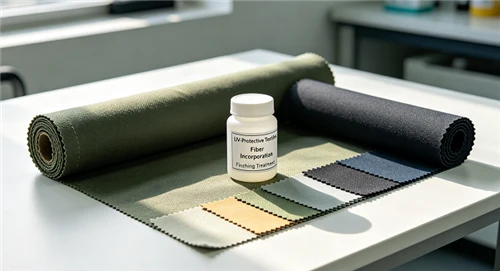
The demand for UV-protective textiles has increased as consumers and manufacturers have become more concerned about protection from prolonged ultraviolet exposure. UV-protective fabrics are used in sportswear, outdoor clothing, hats, umbrellas, curtains, tents, and other products designed for outdoor environments.

One approach is to incorporate UV absorbers or UV-screening materials directly into polymer fibers during the spinning process. Materials such as titanium dioxide and zinc oxide can be incorporated into suitable fiber systems to improve UV blocking performance. Because the UV-protective component is incorporated into the fiber itself, this approach can provide better durability than some conventional surface treatments.
Another approach is the post-treatment application of UV absorbers. Depending on the chemical structure of the UV absorber and the type of textile fiber, UV-protective agents can be introduced during dyeing, padding, finishing, printing, or softening processes. The interaction between the UV absorber and functional groups in fibers such as cellulose, polyamide, wool, and silk can influence its fixation and durability.
Microencapsulation technology provides another method for applying UV absorbers to textiles. In this approach, the UV absorber is enclosed within microscopic capsules and then fixed onto the textile using suitable binders. Microencapsulation can improve the distribution of the active ingredient and may provide more durable UV protection depending on the capsule structure, binder system, and finishing process.
Coating technology is also used for selected UV-protective textile products. UV absorbers can be incorporated into a coating formulation and applied to materials such as tents, outdoor fabrics, protective covers, and hats. After coating, drying and curing, the resulting layer provides an additional barrier against UV radiation. However, the long-term durability, weather resistance, flexibility, and wash fastness of the coating need to be considered during formulation.
三,Choosing the Right UV Absorber
The selection of a suitable UV absorber should not be based solely on its UV absorption wavelength. Polymer compatibility, thermal stability, volatility, color, concentration, processing temperature, weathering conditions, and regulatory requirements all need to be considered.
For example, UV-326 is a benzotriazole-type UV absorber that can be considered for selected plastics, coatings, and polymer systems. Other products such as UV-328, UV-329, and UV-234 have different molecular structures and performance characteristics. The best choice depends on the specific formulation and application requirements.
For high-performance materials, a combination of UV absorber, HALS, and antioxidant may provide more comprehensive protection against photo-oxidative degradation than a single stabilizer. Formulators should therefore evaluate the entire polymer stabilization system rather than selecting an individual additive in isolation.

As the demand for longer-lasting plastics, coatings, fibers, and outdoor materials continues to grow, UV absorbers remain an important tool for improving resistance to ultraviolet-induced degradation. Different chemical families, including benzophenone, benzotriazole, salicylate, and triazine UV absorbers, offer different absorption characteristics and performance profiles.
At the same time, modern UV stabilization is increasingly moving toward integrated systems combining UV absorbers with HALS, antioxidants, and light-screening agents. By selecting the appropriate stabilization technology according to the polymer, processing conditions and end-use environment, manufacturers can improve color retention, weather resistance and the long-term durability of their products.