Sorbitan monooleate (Span 80) can appear on an excipient data sheet as both a water-in-oil emulsifier and an oil-in-water emulsion stabilizer. The two descriptions refer to different formulation roles. In a water-in-oil emulsion, Span 80 can help keep water droplets dispersed in oil. In an oil-in-water emulsion, it can work alongside a more water-soluble emulsifier, such as polysorbate 80. The distinction depends on which liquid surrounds the droplets and which other surfactants are present.

What happens at the oil–water interface?
 Consider a drop of water suspended in oil. Breaking it into smaller droplets creates more surface area where water and oil meet. Sorbitan monooleate is a nonionic surfactant that collects at this boundary and lowers interfacial tension, making it easier to create that additional surface. Once droplets have formed, a different question matters: how does the layer around each droplet respond when its surface stretches or contracts?
Some experts investigated this distinction using water dispersed in paraffin oil. They measured how a layer of Span 80 responded to changes in interfacial area, then examined droplet sizes in emulsions made with the same surfactant concentrations. They found that the mechanical response of the layer helped explain differences between the emulsions. In practical terms, lowering interfacial tension helps explain how droplets form; that measurement alone does not tell a formulator how well the resulting dispersion will hold up.
Why is Span 80 used in water-in-oil emulsions?
In a water-in-oil (W/O) emulsion, water forms the droplets and oil is the continuous phase surrounding them. Span 80 has a greater affinity for oil than for water. Croda reports an HLB value of 4.3 for its pharmaceutical grade and identifies it as a liquid W/O emulsifier. HLB stands for hydrophilic–lipophilic balance: here, the low value describes the emulsifier's relatively oil-loving character.
The oil itself also deserves attention. For example, Croda specifically identifies vegetable oils and oleyl alcohol as lipid components for which its Span 80 grade is useful. That is more informative than the HLB number on its own: it identifies materials with which the manufacturer recommends using the excipient. The value 4.3 describes the surfactant; it does not specify a concentration, predict droplet size, or establish the shelf life of a finished cream.For a closer look at acid value, saponification value and other material specifications, see our guide to sorbitan monooleate specifications.
Why do some creams contain both sorbitan monooleate and polysorbate 80?
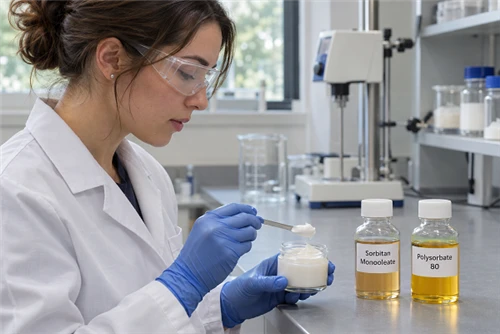
A real example appears on the DailyMed label for XRay Pain Relief Cream. The inactive ingredient list includes both sorbitan monooleate and polysorbate 80. Despite the shared "80," these are distinct excipients. Sorbitan monooleate is the more oil-affine member of the pair.Polysorbate 80, also known as Tween 80, is more hydrophilic. Changing their relative proportions changes the balance of the emulsifier blend. In an oil-in-water (O/W) system, that allows sorbitan monooleate to contribute to a formulation in which water, rather than oil, surrounds the droplets.
The label illustrates a useful limit when interpreting an ingredient list. It confirms that both excipients are present, but gives neither their ratio nor the emulsion type. Seeing Span 80 on a cream label is therefore insufficient evidence that the cream is water-in-oil.
Can the HLB value predict the finished emulsion type?
A soybean oil study offers a particularly clear answer. Experts prepared model emulsions containing 10% soybean oil by weight. They compared Span 80 alone, Tween 80 alone, and blends of the two. Instead of assigning an emulsion type from the ingredients, they checked which liquid could dilute each sample. All the samples could be diluted with water and were classified as oil-in-water, including the sample made with Span 80 as its only surfactant. The authors attributed that result to the low proportion of oil in their experimental system.

That finding explains why both descriptions on an excipient data sheet can be correct. Span 80's affinity for oil helps explain its established role as a water-in-oil emulsifier. Its presence does not dictate the structure of every formulation that contains it. For a pharmaceutical formulator, the useful distinction is between the properties of the excipient and the measured behavior of the complete emulsion. The HLB value describes the former; identifying the continuous phase and observing the droplets provide evidence about the latter.
For product specifications, see Inno-Chem's Sorbitan Monooleate product page.