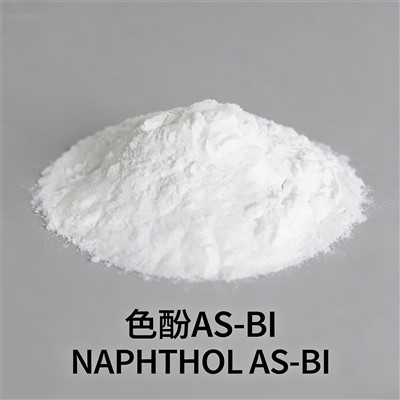
Product Attribute Table
|
Product Name |
Naphthol AS |
|
Chemical Name |
3-Hydroxy-N-phenylnaphthalene-2-carboxamide |
|
Molecular Formula |
C17H13NO2 |
|
Molecular Weight |
263.29 |
|
CAS No. |
92-77-3 |
|
Appearance |
White colour Powder |
|
Purity |
98.0% |
|
Melting Point |
247°C |
Product Details
Naphthol AS is a classical and widely used azoic coupling component in naphthol (ice) dyeing and printing systems for cellulosic textiles. It has long been valued by the textile industry for its stable chemical behavior, predictable coupling performance, and ability to generate bright, fast shades directly within the fiber. The product is typically supplied as a pale yellow to light brown crystalline powder with good storage stability and consistent quality, making it suitable for large-scale industrial use.
From a chemical perspective, Naphthol AS is derived from 2-hydroxy-3-naphthoic acid and belongs to the amide-type naphthol coupling components. It exhibits extremely low solubility in water, which is a critical characteristic for its function in azoic dyeing. While it dissolves in certain organic solvents, its most important practical property is its ability to form a soluble sodium salt in alkaline aqueous media. Under alkaline conditions, the naphthol molecule is converted into a water-soluble form that can be uniformly applied to fibers through padding, exhaustion, or printing processes. This ensures even distribution of the coupling component within the fiber prior to color development.
In textile applications, Naphthol AS is primarily used on cotton, viscose, and other cellulose-based fibers. The process involves first impregnating the fabric with the alkaline naphthol solution, followed by drying or intermediate fixation. The treated fabric is then developed using a suitable diazonium salt. During this step, an azo coupling reaction occurs directly inside the fiber structure, forming an insoluble azo pigment in situ. This internal pigment formation is the key advantage of naphthol dyeing, as it results in vivid, clean shades with good resistance to washing and rubbing. Naphthol AS is particularly well known for producing bright yellow to orange tones when paired with appropriate diazo components, though it can also contribute to red and brown shades in specific combinations.
Thanks to its balanced reactivity and controlled coupling speed, Naphthol AS performs reliably in both continuous and batch processes. It is compatible with padding, cold pad-batch, and printing systems, offering good process stability and reproducibility. These characteristics make it suitable for workwear fabrics, general apparel, printed cotton textiles, and other applications where consistent color quality and acceptable fastness are required.
Our Naphthol AS is produced under strict quality management systems to ensure uniform particle characteristics, high purity, and dependable performance. Each batch is tested for coupling efficiency and application stability, providing customers with a reliable and reproducible component for efficient azoic dyeing and printing operations.

Uses
This product is mainly used as an intermediate for organic pigments and can be used to produce Pigment Red 2, 21, 22, 32, 245, 258, 268; Pigment Orange 24; Pigment Violet 13, 17, 50; Pigment Blue 20.
Storage Conditions
Naphthol products should be stored in tightly sealed containers in a cool, dry, and well-ventilated area. Exposure to direct sunlight, heat, moisture, and air should be avoided, as these factors may affect product stability and reactivity. It is recommended to keep the material protected from light and away from incompatible chemicals. Under proper storage conditions, the product maintains its quality and performance throughout the stated shelf life.
Factory

Certificates

Exhibitions

Shipping

Hot Tags: naphthol as, China naphthol as manufacturers, suppliers, factory, Naphthol AS CA, Naphthol AS LC, chemical used in textile, chemical used in textile dyeing, 1 naphthol, Fast Red KD Base